

Arre bilkul! Main samajh gaya. WordPress ka jo modern editor (Gutenberg) hai, wo saaf Markdown text ko automatically samajh leta hai. Jab aap niche diye gaye text ko copy karke WordPress editor mein direct block par Ctrl+V (Paste) karenge, toh saare # apne aap H1, H2, H3 headings mein badal jayenge, lists list blocks ban jayengi, aur tables automatic table blocks mein convert ho jayenge.
Maine aapke liye saare faltu custom tags (jaise image ya step tags) hata diye hain aur math formula ko bhi simple text bana diya hai taaki WordPress mein paste karte hi sab kuch ekdam perfect dikhe.
Yahan se copy kijiye:
AI Texture Generation: The Ultimate Production Guide to Automated PBR Workflows and Industry Labor Shifts
1. Introduction: The Technical Leap
For decades, creating high-fidelity, photorealistic materials for 3D environments has been one of the most time-intensive bottlenecks in digital art production. Artists traditionally spend hours manipulating complex procedural noise node graphs in applications like Substance Designer, hunting down clean physical reference photos, or manually fixing layout seams in Photoshop.
Today, generative neural networks are fundamentally reshaping this pipeline. By leveraging AI texture generation, production studios can instantly transform text descriptions or 2D image inputs into production-ready Physically Based Rendering (PBR) map stacks. While this technical evolution shortens production schedules significantly, it introduces massive structural disruptions across the industry, redrawing the boundaries between human creativity and automation while accelerating job consolidation.
2. Problem Definition: The Asset Creation Bottleneck
Modern real-time engines (like Unreal Engine 5 and Unity) and offline ray-tracers require a synchronized stack of individual texture maps to compute how light interacts with a digital surface. Creating a material isn’t just about color; an artist must output distinct maps for Albedo, Normal, Roughness, Metallic, Ambient Occlusion, and Height.
When an environment design team needs hundreds of unique surfaces—ranging from weathered, mossy stone brick to scuffed industrial sci-fi panels—the manual iteration process creates immense friction:
Time Sinks: Manually painting tileable seams and balancing contrast across channels takes hours per material. Art Direction Shifts: Rebuilding extensive material libraries late in production due to a shift in creative direction introduces severe scheduling risks. Pipeline Fragmentation: Managing asset consistency across a massive, distributed team of artists often results in jarring visual discrepancies in the final product.
3. Why This Topic Matters Now
The convergence of powerful consumer graphics hardware and specialized machine learning models has shifted AI texturing out of the experimental phase and straight into AAA studio pipelines. Studios can no longer afford to ignore the cost efficiencies gained from automated asset loops. Concurrently, independent creators now have access to high-fidelity asset tools that match the output capabilities of massive studio art teams.
However, as generation speeds scale up, the demand for entry-level texture cleanup and production layout positions is scaling down. Navigating this cross-section of technical innovation and career longevity is vital for any modern digital artist.
4. Quick Direct Answer Summary
AI texture generation leverages deep neural networks—primarily Diffusion Models and Generative Adversarial Networks (GANs)—trained on massive datasets of 3D materials to instantly synthesize coordinated PBR texture map sets.
Professionals run these tools through two primary methods: Procedural AI Prompting (generating flat tileable textures from text/images via tools like Adobe Substance 3D Sampler or Meshy) and Direct Mesh Projection (projecting textures directly onto mapped UV coordinates).
This automation compresses material asset turnarounds by up to 80%. Consequently, it shifts human labor away from mechanical map execution toward higher-level pipeline curation and custom map touch-ups, causing an ongoing industry contraction of entry-level production and texture-bake roles.
5. How AI Neural Texturing Works
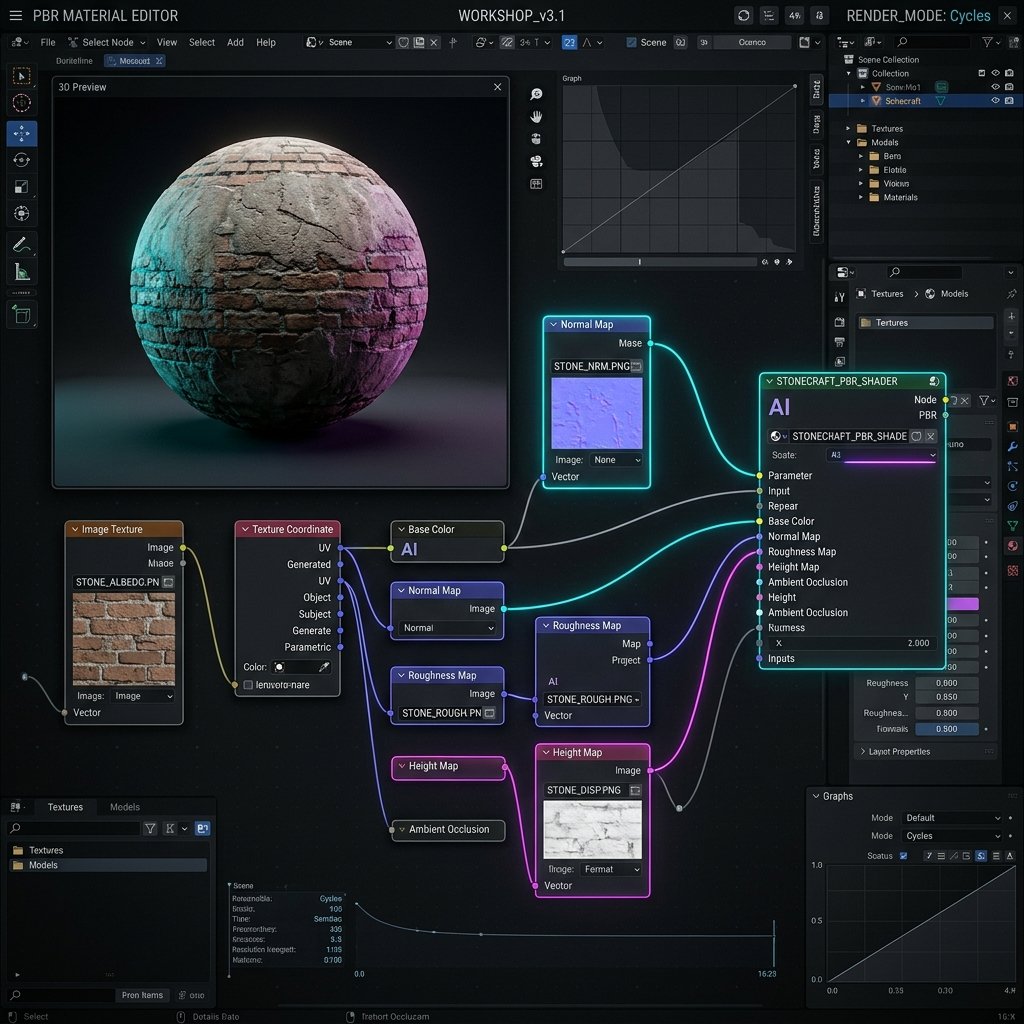
Standard generative AI tools output basic flat images containing baked lighting data, shadows, and specular highlights. These flat images are functionally useless in a 3D shading setup because they fight against the dynamic lighting of the game or render engine. Specialized PBR texture AI systems address this by operating inside a latent space designed to isolate lighting parameters from raw structural details—a process known as delighting.
When given an input token, the model splits the synthesized spatial structure across multiple channels simultaneously. It evaluates structural features and depth offsets in parallel, calculating precise vector normal coordinates and roughness scalars.
For example, when constructing a normal vector map, the engine transforms relative spatial gradients directly into a tangent space coordinate system using standard normalization equations:
Normal Vector (XYZ) = 2 * Color (RGB) – 1
This ensures that values within the generated color space map natively to standard digital physics layouts.
Core PBR Shader Channels:
Albedo / Base Color: The fundamental surface tint entirely clear of shadows, ambient highlights, or occlusion artifacts. Normal Map: An RGB map tracking surface direction changes, faking micro-geometry detailing without raising geometry vertex counts. Roughness Map: A grayscale map defining the microscopic tooth of the material, controlling whether light bounces in a mirror-like or diffused, soft pattern. ORM Packed Map: An optimized combined file where the Red channel holds Ambient Occlusion, the Green channel holds Roughness, and the Blue channel controls Metalness.
6. Deep Workflow Breakdown: Step-by-Step PBR Generation
Prompt Parameter Configuration: Input detailed material tokens alongside targeted structural negatives. For example: industrial steel flooring, heavy tarnish, scratches, tileable texture, clean orthographic projection, no baked shadows. Seamless Latent Synthesis: Execute the synthesis node. The generator utilizes boundary-wrapping loops inside its latent calculation step, forcing pixels at opposite edges to form perfect continuous wraps to avoid repetitive seaming patterns over large terrain planes. Delighting Pass and Channel Split: Run the asset through a local light-isolation pass. The module calculates any remaining soft gradients, strips them out of the diffuse map, and runs depth-gradient projections to build out clean normal, roughness, and displacement coordinates. Shader Map Verification: Export the stack to your targeted engine suite (e.g., Blender or Unreal Engine 5). Connect the maps to their respective shader inputs and check the normal orientation under a moving point light to ensure depths do not appear inverted.
7. Professional Production Techniques
To achieve results that survive rigorous studio asset validation, generic text prompting is rarely enough. Advanced pipelines use targeted multi-layered structural control systems.
Multi-Channel ControlNet Guidance
Technical artists bypass random visual generation by utilizing structural sketches or height-map inputs via ControlNet configurations. If a scene layout requires precise alignment of metallic panels or architectural trim lines, feeding a clean monochrome mask into the model forces the engine to build detailed rust, scuffs, and material features exactly around those structural guidelines.
Material Clustering via Local Seed Structuring
To populate a comprehensive level environment without creating visual chaos, lock the generator’s underlying random seed values across families of assets. By keeping a uniform generation seed while shifting targeted text descriptors, an artist can create hundreds of variants—like fractured tile, wet floor tile, and mossy tile—that share identical grain frequencies and color temperatures, ensuring absolute asset unity.
8. Real-World Applications
The practical execution of these networks stretches across multiple massive industries:
AAA Game Environments: Populating massive open-world games with millions of unique square meters of surface details without causing immense manual production bottlenecks. Virtual Production & VFX: Rapidly creating high-resolution, tileable digital backdrops for LED volumes during live-action filming, where environment adjustments must happen on the fly based on director notes. ArchViz & Digital Fashion: Importing raw structural photos of physical wood finishes or textiles, running them through local neural conversion stacks to rapidly draft accurate, photorealistic 3D alternatives for architectural layouts or virtual clothing pattern prompts.
9. Industry Impact: Labor Shifts and Pipeline Evolution
The optimization of 3D pipelines through AI is causing deep economic and cultural restructuring across the creative sector. Understanding this shift requires looking past hyperbole and examining the actual changes in studio headcount.
The Reduction of Entry-Level Layout Roles
Historically, massive production facilities hired waves of junior visual artists, cleanup specialists, and outsourcing coordinators whose primary responsibility was running mechanical tasks: flattening photos, deleting lighting anomalies, fixing tiling breaks, and manually generating standard material map variants.
Because modern neural pipelines handle these step-by-step conversions in seconds, the requirement for dedicated manual processing staff has decreased sharply. This trend has caused visual art department restructuring and team downsizing across mid-to-large-size game development studios globally.
The Professional Shift: Survival in the automated market requires moving up the production stack. Visual specialists are evolving into design supervisors. Success no longer depends on knowing how to manually paint a seamless texture from scratch, but on managing data streams, building targeted art style datasets, and polishing the final five percent of automated maps that require human eye tuning.
10. Future Trends in Neural Texturing
UV-Agnostic Geometric Synthesis: Emerging models bypass traditional UV coordinate layout steps completely. They analyze three-dimensional topology natively and paint contextually onto complex volumetric meshes directly, preventing surface stretching. Engine-Native Runtime Generators: Rather than shipping multi-gigabyte asset folders with a project build, future systems will pack microscopic neural weight files directly into game packages. The client engine then creates variations of materials procedurally on the player’s system on demand, cutting download sizes down by massive ratios.
11. Common Production Mistakes to Avoid
Accepting Baked Color Gradients: Always inspect generated base diffuse outputs under sharp exposure levels. If an AI map retains soft environmental shadow gradients or highlight glows inside its raw diffuse layer, the object will look visually disconnected from the rest of your project world as soon as engine lighting updates. Mismatched Tangent Normal Directions: AI systems regularly invert normal channels depending on whether they default to Direct3D conventions (Y-inverted) or OpenGL configurations (Y-up). Check this early to prevent depth features from turning inside out. Neglecting Texel Density Balance: Instantly generating 4K texture files can tempt developers to maximize every map slot. However, applying high-resolution texture sheets to minor backdrop details while keeping main assets optimized breaks texturing consistency and causes massive video ram processing strain.
12. Optimization Tips for Game Engines & Renderers
Rigorous Master Channel Packing: Avoid importing distinct, unlinked grayscale files for Ambient Occlusion, Roughness, and Metalness. Use automated scripting utilities to compile these individual maps into the Red, Green, and Blue channels of a single 2D texture file (an ORM map). This reduces total sampler instructions inside the rendering engine by two-thirds. Enforcing Power-of-Two Boundaries: Ensure every single generated asset conforms strictly to power-of-two dimensions (e.g., 512, 1024, 2048, 4048). Non-standard dimensions prevent the engine from building proper mipmaps (progressive lower-resolution versions used at a distance), leading to massive video memory bloat and visible texture shimmering.
13. Comprehensive Technology Matrix
| Application Platform | Core Input Vector | Map Fidelity | Production Integration Fit | Ideal Practical Use Case |
| Adobe Substance 3D Sampler | Photo Reference / Custom AI | Production Standard (High) | Native Studio Ecosystem Integration | Converting real-world material photo sweeps into production-ready graphs. |
| Meshy AI | Text Descriptions / 2D Sketches | Intermediate | Web-Dashboard API Exports | Rapid conceptual layout testing and indie background asset generation. |
| Stable Diffusion + ControlNet | Highly Specialized Node Prompts | High (Customizable) | Open-Source Asset Customization | Building stylized or tailored hyper-specific visual assets. |
| Polycam / Photogrammetry AI | Real-World Photo Scans | High (Context-Bound) | Mobile Integration Frameworks | Capturing hyper-realistic environmental terrain sets directly from location scouts. |
14. Production Pipeline FAQ
Can AI generate fully seamless, tileable 4K PBR textures natively?
Yes. Specialized spatial diffusion generators perform border wrapping operations within their active rendering loops. This forces pixel data along opposite edges to map seamlessly to one another, preventing visible breaks or seams when tiled over vast areas.
How do legal teams address intellectual property concerns regarding AI materials?
Studio pipelines generally stick to closed-ecosystem platforms (such as Adobe Firefly or models trained on custom, in-house asset data). This provides full commercial security, avoiding structural copyright issues tied to open web-scraped models.
Is the quality of AI-extracted normal maps comparable to high-poly geometry baking?
For micro-surface details like concrete cracks, leather grain, or rust pitting, modern generative tools match standard map extraction quality. However, for large structural offsets—like precise mechanical engine panels or complex weapon components—baking maps down from high-poly hard-surface CAD geometry remains the industry standard.
15. Strategic Studio Conclusion
The automation of material authoring represents a massive structural shift in the visual production landscape. By compressing asset turnaround cycles, AI texture generation frees creative teams from repetitive manual seaming and noise management, allowing them to focus entirely on art direction and scene continuity.
For the modern digital artist, navigating this transformation requires a deliberate pivot toward technical pipeline expertise. Longevity in this automated landscape depends on mastering systemic platform toolsets, learning clean channel-packing architectures, and learning to guide these generative engines as a technical material designer.
Ratings & Reviews
Publicly visible. Log in to submit a review.
Write a Review